The Newest Technologies Being Used in Orthotics & Prosthetics
At Scottish Rite for Children, we are committed to providing to best and most innovative care – making sure we do everything we can to help each child accomplish their goals. Our Orthotics & Prosthetics department create custom-made orthoses and prostheses for patients with special orthopedic needs.
With a team of trained orthotists and prosthetists at our Dallas and Frisco campuses, they are using the latest technology to help each patient be the best they can be. Learn more below.
Microprocessor Knee
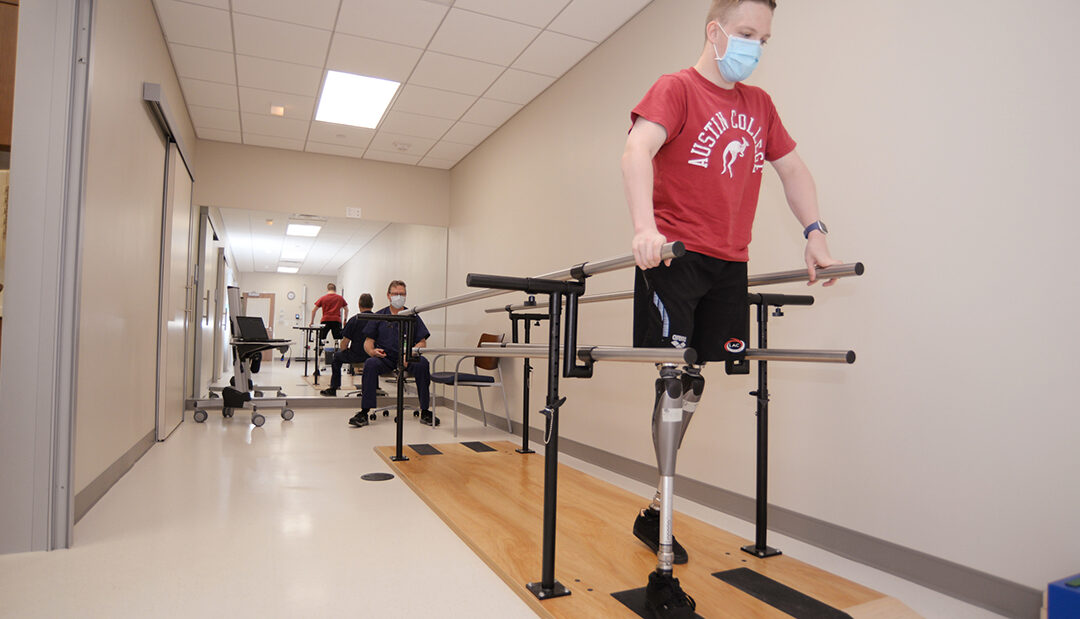
A microprocessor knee is a specialized component for a transfemoral (amputation above the knee) prosthesis that can provide more stability for the patient. It has a computer in the knee that knows every movement. This knee is great for active patients that want to fear less about falling and more about their surroundings.
What is the most common patient population that we are using this device for?
Active adults that do a variety of activities. This technology is great for our older patients.
What makes this different than our standard prosthetic knee/leg?
A traditional knee requires more effort from the patient to keep it stable. These knees can buckle and lead to falling. These instances are rare but they do happen. Every amputee falls at some point, but research shows that a microprocessor knee decreases that frequency of falling because it can adapt on its own rather than the patient catching themselves with a traditional prosthetic knee.
There are pros and cons of both types of knees. The key is to make the best selection for each patient based on their needs. These microprocessor knees also allow the patient to switch it between modes. These modes change the settings of the knee to allow for different activities such as skiing, cycling, badminton, etc. – which is a unique feature to the technology.
Is there a certain age range that this type of device is better for?
For our patient population, it is mostly selected for those patients graduating high school and moving on to other exciting chapters in their lives outside of Scottish Rite.
IDEO Brace
The IDEO brace is an ankle foot orthosis (AFO). It provides stability to the foot and ankle for patients who have weakness in their lower extremities.
The benefit of this brace is that it is made of carbon fiber. Therefore, it offers some energy return and spring back during walking. This brace is very strong and is harder to break. We work with children that sometimes break their braces frequently because they are so active.
What makes this different than our standard orthosis?
The biggest difference between this AFO and many other AFO’s that we do is that it is a carbon fiber brace. It has a carbon fiber strut on the back of the brace that allows for some spring back during ambulation. This strut can be interchanged with those of different stiffness’s. This allows for the patient to put in a different stiffness of strut depending on the activity that they are doing, offering more or less spring. The IDEO brace includes a cuff just below the knee that fits snug on the leg to help offload the foot. This is important for an individual with a wound or injury that cannot put weight through their lower extremity.
Is there a certain age rage that this type of device is better for?
It is typically used for older children and adults.
Learn more about our Orthotics & Prosthetics department.