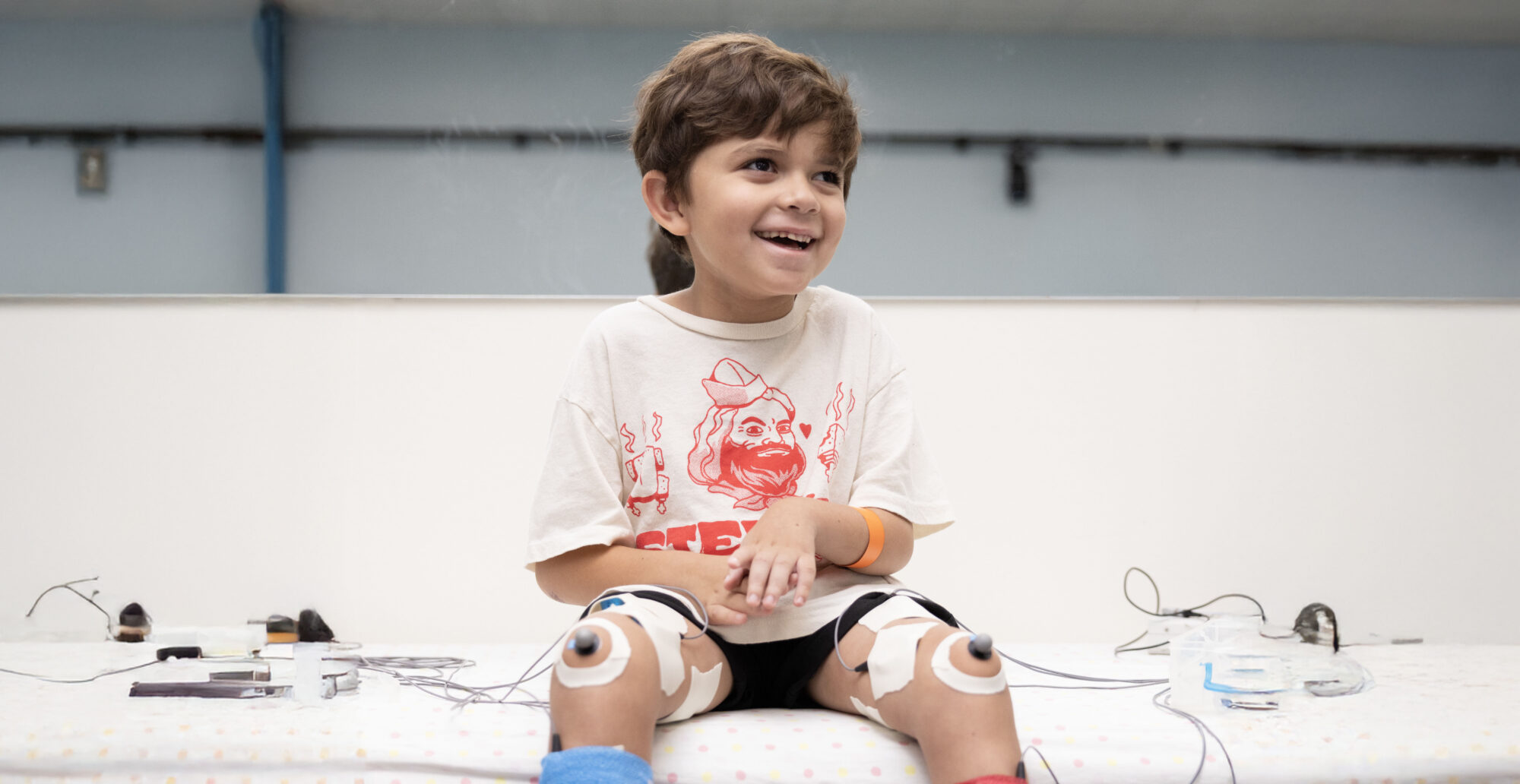
Gait analysis measures how your child walks and moves using video and specialized sensors. It helps your child’s team understand what drives walking differences. We use the results to guide care decisions and track progress over time.
Our Approach to Gait Analysis
When your child walks differently, you may notice tripping, fatigue or uneven steps. It can feel unclear what is causing the problem or what will truly help.
At Scottish Rite, we use gait analysis to understand how your child’s body moves in real time. Our Movement Science Laboratory (MSL) in Dallas, or Gait Lab, incorporates technology to look beyond what the eye can see in a standard exam. We measure how joints move, when muscles activate and how much power your child generates while walking.
Because children are still growing, their walking patterns naturally change. Because growth affects movement, we interpret gait data through a pediatric lens to guide safe, age-appropriate decisions.
We use gait analysis to:
- Help determine whether certain gait differences may improve with surgery or other treatments
- Refine therapy or bracing plans
- Establish a baseline before treatment
- Evaluate walking before and after surgery or therapy to measure improvement
Gait analysis does not stand alone. We review your child’s results alongside physical exams and imaging before building a coordinated plan.
This approach helps your child:
- Receive more precise treatment
- Improve walking efficiency and comfort
- Track measurable progress over time
- Stay active and engaged in daily life
We focus on meaningful improvements that support participation, independence and long-term mobility.
Types of Gait Analysis Testing
Your child may undergo one or more of the following:
- Clinical Examination: Staff will evaluate the flexibility and strength of the hip, knee and ankle joints.
- Video Assessment: Staff will record walking and movement patterns from multiple angles to document how your child moves.
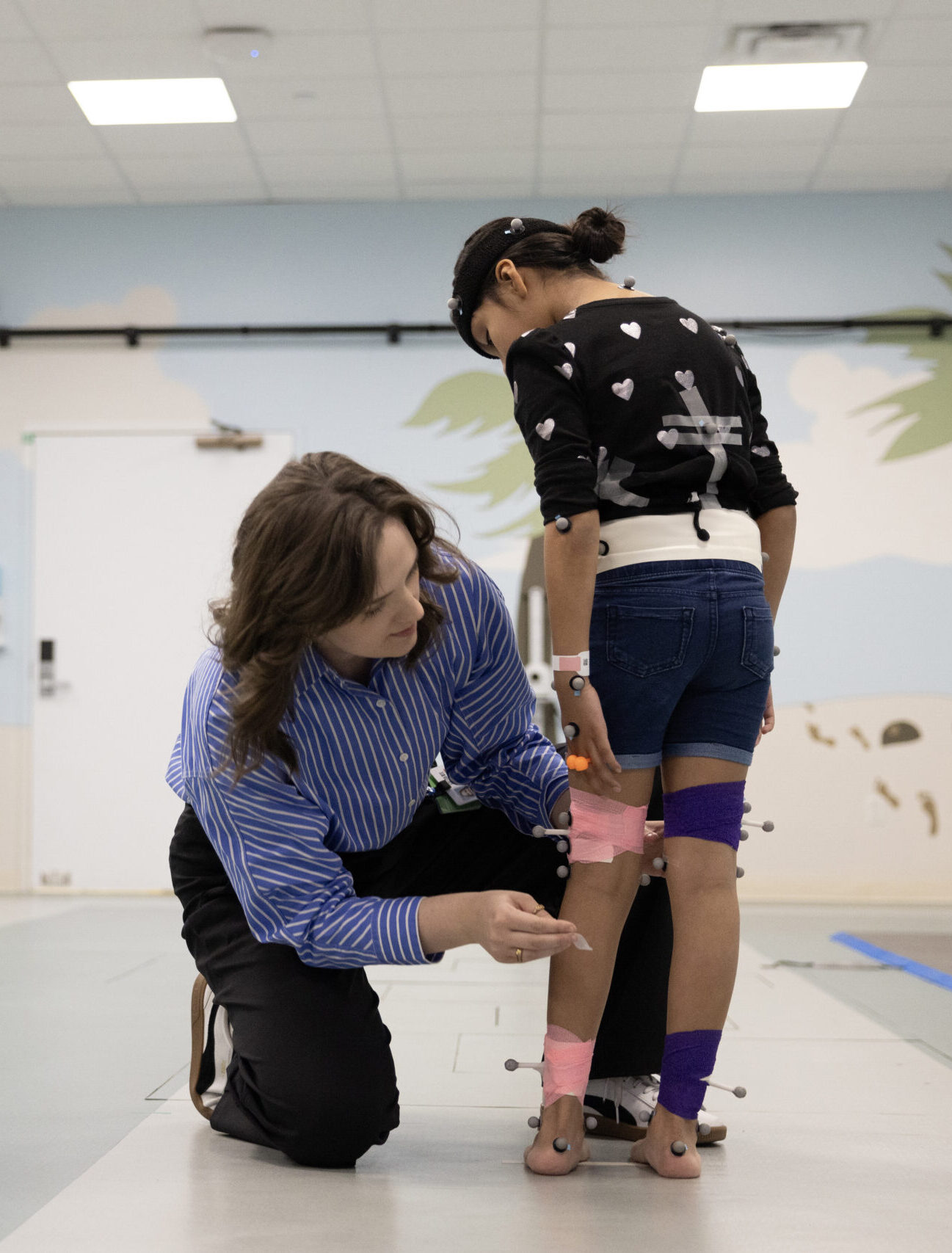
- 3D Motion Capture: Small reflective markers and multiple cameras measure your child’s joint movement in three dimensions while performing certain tasks, like walking, running or squatting.
- Electromyography (EMG): Small sensors will be placed on your child’s leg to record when muscles turn on and off during walking. These sensors only record signals and do not stimulate muscles.
- Foot pressure analysis: Your child will walk barefoot on a special plate that measures the pressure under each foot.
- Strength testing: The lab measures joint strength as the leg pushes or pulls against a specialized machine through a full range of motion.
- Oxygen consumption testing: This test measures energy use and breathing during activity.
Benefits of Gait Analysis
Gait analysis helps your child’s care team:
- Identify subtle movement patterns that are hard to see during a standard exam
- Understand which muscles overwork, underwork or fire at the wrong time
- Determine whether therapy, bracing, orthotics or surgery may help
- Contribute to the creation of a treatment plan based on objective measures, not guesswork
- Track progress after treatment and adjust care as your child grows
Your care team will explain what the results mean and how they relate to your child’s goals.
What to Expect During Gait Analysis
Your child will complete testing within one visit in our Gait Lab. Most visits last one to two hours, though the total visit length varies by the evaluations ordered. A team member will explain each step in kid-friendly language.
Before the Test
Bring any equipment your child uses, such as braces, prostheses, a walker or crutches, to name a few. Your child should plan to wear athletic shorts with an elastic waistband, and a t-shirt or tank top during testing. A sports bra may also be helpful for some patients.
During the Test
While the equipment may look unfamiliar, our team takes time to help your child feel comfortable. The team will place markers and sensors on your child’s skin using medical tape. Your child will walk and perform simple movements while the team records data.
The test does not hurt, but removing tape can feel similar to removing a bandage.
Parents or guardians usually stay in the lab during testing. Some older children or teens may prefer more privacy.
After the Test
We will review your child’s results and explain what they mean. Then, we discuss next steps at a follow-up visit or during your next clinic appointment.
Why Choose Us
Research that informs care: Our Movement Science Laboratory supports ongoing research to improve treatments for children with orthopedic and neuromuscular conditions. Findings help refine care for current and future patients.
Advanced pediatric motion technology: Our Movement Science Laboratory is one of the few in the region focused solely on children. We use specialized 3D motion capture and muscle testing technology. This level of detailed movement analysis is not available in most standard clinic settings.
Coordinated pediatric specialty care: If gait analysis shows your child may benefit from surgery, therapy or bracing, our specialists can act quickly. Since care can happen within Scottish Rite, results move directly into next steps.
-
Gait analysis does not accept outside referrals. A Scottish Rite specialist must refer your child for testing as part of a care plan. Whether gait analysis may benefit your child will be determined by your Scottish Rite care team.
-
No. The test is painless and does not involve needles or surgery.